
Learn Abstract Painting with Focus on Color, Design, and Personal Expression
May 22, 2026Abstract painting allows artists to communicate their emotion. They get to show their imagination without always depending on realistic subjects. Strong color choices, thoughtful design structure, and authentic personal expression are key attributes of abstract paintings. Their paintings evoke both visually stunning imagery and deeply memorable impressions. Focus on color, balance and expression- artists can then effectively utilize techniques which promote more confidently portrayed, clearly defined artwork. Expanding creative expression through greater design knowledge to learn abstract painting with focus on color, design, and personal expression results in better artistic identities for the artist and a more emotive interpretation through abstract expression styles. Art and Success lets you know how to begin a large-scale abstract painting without fear or hesitation.
Learn Abstract Painting with Focus on Color, Design, and Personal Expression
Learn abstract painting with focus on color, design, and personal expression by following the points below:
1. Understand the Emotional Power of Color
Within abstract painting, color is the key driver in emotional engagement. Warm tones bring excitement, dynamism and vivacity to a canvas, while cool tones invite calm, thoughtful moods. Artists acquainted with color psychology gain the ability to communicate emotion to abstract compositions at a deeper level; the art becomes richer and better compositionally structured, whether displayed large or small.
2. Build Strong Composition Through Design Principles
Abstract works require well-balanced structures to work. Learn abstract painting with focus on color, design, and personal expression such as movement, contrast, emphasis, repetition, balance and negative space guides viewer attention through the composition logically; artists achieve powerful visual compositions that do not seem chaotic or overwhelming by using strong visual directionality.
3. Use Texture to Increase Visual Interest
Texture adds layers of depth and dimension to abstracts, painting with texture adds a visceral richness. Combining tools and media such as pallet knives, paint, modeling paste, and collage materials produces much more layered and engaging images than if these media are used individually. The surface can become more reactive to light, thus promoting greater movement and expressiveness within the composition.
4. Develop Personal Expression Through Experimentation
An artist's style begins with exploration. Colors, marks, medium applications, and compositional ideas must be freely experimented with if they are to produce and grow the individual artistic vision. Often, artists can stumble upon unique styles using atypical methods, building more confidence and a more easily identifiable identity as well as an authentic emotional tone within their creations. The right color and design strategies for expressive abstract paintings helps in attaining this.
5. Create Movement Using Brushwork and Shapes
Movement captures the attention of viewers; visual flow helps people's eyes travel across a canvas with fluid ease. Curve and shape, stroke direction and texture all work in tandem, increasing the vibrancy and dynamism of abstract pieces to draw them in more strongly, strengthening the art without the reliance on representational subjects.
Learn abstract painting with focus on color, design, and personal expression at Art and Success!
How to Begin a Large-Scale Abstract Painting without Fear or Hesitation
Approaching the challenge of a big, blank abstract canvas often can present a barrier for artists-fear of making mistakes, wasted materials or pure creative paralysis; structured steps, however, can make the daunting canvas easier to confront, more conducive to creative pursuits. Read to understand how to begin a large-scale abstract painting without fear or hesitation.
1. Begin with Loose Sketches and Small Studies
Tiny experiments of both shape and color can give artists a chance to visualize compositions before committing to a large canvas, reducing the pressure of potentially damaging a huge piece, as well as boosting their color placement, movement and focus planning. These mini-compositions translate directly to larger-scale artwork smoothly.
2. Focus on Large Shapes Before Small Details
A large abstract should be composed of bold forms, overall design balance and major color compositions prior to adding the minutiae. In most cases, detailing can obstruct movement in a work and dilute a strong, unified composition; starting with the macro scale and working inwards enhances visual coherence and emotionality in any painting.
3. Accept Imperfection During Early Stages
Abstract art is an ever-evolving entity which involves layering and a process of change. While the early steps are important, they are just the beginning of the composition. Uncertainty helps create greater dynamism and less anticipated compositional possibilities while dramatically reducing artist expectations for perfectionism; they allow for a truly authentic style.
4. Use Physical Movement to Create Energy
A large abstract is a workout, for both the body and the art. Visualizing and developing works through the full range of physical gestures creates both fluidity and excitement in a piece, drawing viewers in. From a distance, artists can see the entire painting and create much more dynamic strokes with greater impact on the viewer than working close up.
5. Build Layers Gradually for Better Depth
Abstract compositions become richer and deeper when layered over time; wash, texture, shape, color variation and mixed media all can contribute to three-dimensional qualities over a broad spectrum. Artists build compositions piece by piece, thereby making it easier to be more relaxed about the artistic outcome since it builds layer by layer.
Color and Design Strategies for Expressive Abstract Paintings
When colors are balanced correctly, as well as composition structured properly, a strong communicative ability of emotions, motion, and overall mood may develop from abstract artwork. Know the top color and design strategies for expressive abstract paintings.
- Use Complementary Colors for Strong Contrast
Placed on opposite ends of the color spectrum, complementary hues offer intense contrast when utilized as dominant shades in expressive abstracts, and make certain areas of focus pop vibrantly compared to one another.
- Balance Bold Areas with Neutral Space
By adding negative space, the artwork appears less cluttered; positive, vibrant areas become better able to shine without a cacophony, thereby adding visual appeal and emotional composure.
- Repeat Key Colors Across the Composition
Repeated color application ensures visual unity and motion between sections of the piece, bringing it together with a unified feeling.
- Combine Organic and Geometric Shapes
Shapes of varied types create dynamism: curvilinear forms offer a spontaneous and organic feel, while geometric shapes provide order and stability. Both together produce images that appear more visually dynamic.
- Vary Texture and Surface Quality
The contrast between smoothness and a rougher, three-dimensional surface quality within a piece can add depth. Light reflects differently from textures, increasing visual dynamism.
- Strengthen Focal Points Through Design Direction
Strategic composition, such as focused shape application, contrast and directional strokes, directs the viewers' eye to a desired center point, which gives strength and narrative power.
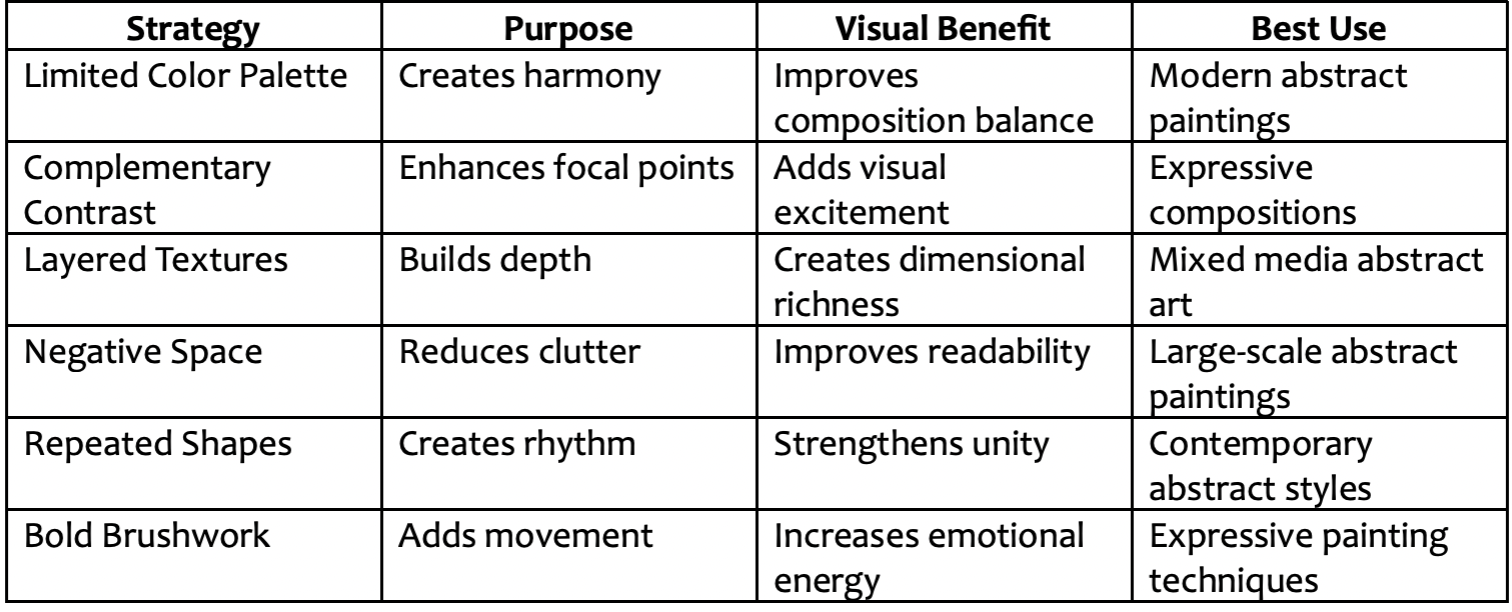
Abstract Painting Design Strategy Table
FAQs
What is the best way to start learning abstract painting?
Start by actively working on color harmony, compositional principles and mark-making in addition to viewing the works of successful abstract artists for inspiration.
Why do large abstract paintings feel intimidating?
The canvas size itself can create the psychological pressure that there might be lost time, lost materials and ultimately a bad painting on one's hands. Planning ahead of time with a smaller-scale composition is effective at overcoming this anxiety.
How important is color in expressive abstract painting?
Color is arguably the most significant component in an expressive abstract composition in terms of conveying emotionality, movement, visual harmony and balance as well as focus.
Conclusion
Mastering color and design, in addition to cultivating individual expression, will equip you with an artistic foundation for creating moving abstract paintings. Improving compositional knowledge, layer texture, directional energy and harmonious color will empower the artist with greater confidence and stronger creative identification; art students who actively practice consistent exploration of their visual voice, and also incorporate careful design considerations, will create visually striking works rich in originality and emotion. To learn the best color and design strategies for expressive abstract paintings, get in touch with Art and Success!
FREE GUIDE
Five Must Have Studio Tools Each Under $20
Sign up now to get instant access to the free guide that reveals the 5 most important tools that I always have by my side!
We hate SPAM. We will never sell your information, for any reason.
